We're at the point in the building of our new old farmhouse that we're starting to think about some finishes. That means Nat is trying to wrangle all the choices with counters and tile and colors and trim and such. But it also means things like railing hangers and garage floor epoxy and doorbells.
Yeah...doorbells.
And Nat and I have been looking around online to find a doorbell that we both like and while there are some neat ones that seem right, I just haven't found anything that I'm in love with. I know...it is just a doorbell. But, I loved our last one. And I want to love this one.
That's lead me to this crazy idea: what about a mechanical doorbell?
See the photo above? That's the 'outside' part of the mechanical doorbell. You have to 'turn' the dial to ring the bell. Below is a photo of the 'bell' part that would sit inside the house.
Remember, we're trying to build a #NewOldFarmhouse. We're already using some salvaged house parts like our windows. And the knobs that Nat has chosen are really awesome and fit the whole 'new old' thing. I'm thinking this doorbell would fit that theme, too? But is it obnoxious?
How does it work? Well, check out this video below that shows both parts.
The video shows a small rod connect the two parts. Because that's how you would mount it to a door. That's about the thickness of the normal door. But, I think we love our new front door a bit too much to want to drill into it. Also, there's lots of glass on it, so it might not work.
But, what about mounting this right where the normal doorbell button would go? Like right next to the door? Turns out, that's doable. I asked our builder what the final thickness of the wall would be after the siding is put on the outside and the drywall is put on the inside and he said it was in the 7" range.
If you check out this listing on the Vintage Hardware site, you'll see that they offer this mechanical doorbell operator that comes with a 10" long rod. And that you can easily trim the length of the rod to make it work for your specific size.
So, instead of having a doorbell with a electric chime, we'd have one of these.
Am I crazy?
That video makes me think the bell is loud enough? But, Nat is worried that our doorbell would need to come with 'instructions'. "How would the UPS guy know how to ring the bell?"
My answer is that there *are* instructions, right? Look at that photo above again: it says 'turn'.
Also, you've seen the Sebastian Maniscalco routine about what happens today when someone rings your doorbell? LULZ. But, true. People don't just 'pop over' these days, right? So, the doorbell isn't used all that much unless you're expecting company? In that case, we'd be listening for it, right?
Give this a watch.
If you came up to a house and saw that mounted to the outside of door, would you know to turn it to ring the doorbell?
Since the new year, I've posted about a couple of spots that I'm thinking about for trees in 2020. That started with the five trees that I want to plant in the front yard ( including five new trees ) and a small section between the espalier Linden trees and a Cleveland Pear along the southern fence line. In both of those pieces, I talked quite a bit about columnar trees. At this point, you're probably like: we get it, Jake. You like columnar form. Yes indeed. But, because this is *my* blog, you're going to have to bear with me. Over the course of the next few days and weeks, I'm going to use this space as a reference guide for some columnar trees that I've come across that are work referencing back as I add more inventory. This post is about a pair of what I'm calling 'white trees'. Birch and Aspen. First up is this Dakota Pinnacle Birch Tree . The folks at Fast Growing Trees are currently selling a 5-6' version for $99 righ...
Move over vegetable garden and garage pavillion, there's potentially a new entrant into the currently crowded backyard at the Parrillo household. Behold: this beauty. The Cedar Summit Panorama Playset from Costco. Comes with 3 swings and a tube slide. Nat spotted this behemoth at Costco and after doing a bit of comparison shopping at a place like Menards (more expensive, I think) and Wannemaker's (don't sell these type of things any more), it appears to be a fair deal. It is a kit - so I'd be putting it together myself, but I'm up for that challenge. The real issue is getting it home. I'm going to head back to Costco to take a look to see if it will fit in Nat's car with the back seats folded down. If not, it seems like I'll be renting a truck from Home Depot. Yes, the Babe is likely too small for a lot of this, but certainly NOT the swings. We take her to the park on a regular basis and she gets a kick out of the swi...
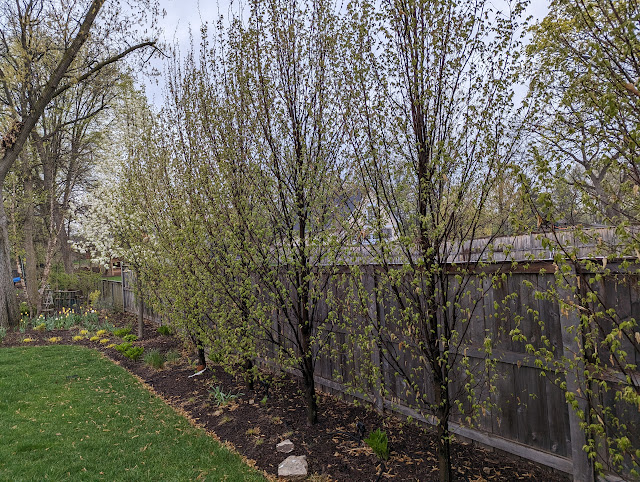
Our hedge of Frans Fontaine Columnar Hornbeam trees is waking up for Spring and has begun to leaf-out all over the trees. The last time that I looked at these trees was earlier this (late) Winter, when all of the trees were still clinging to some of their previous-season's leaves (something called foliar marcescence). The screening that comes from planting these Frans Fontaine Hornbeams along the property line is starting to come into focus this growing season as the small leaves are opening from their buds. Below, is a photo showing the current (mid/late April) state in our yard in Northern Illinois (Zone 5b). And, here below, is a look at the leaf from the Frans Fontaine European Hornbeam (Fastigata). They are curled and ribbed with a hob-like flower/fruit on the trees It won't be long until they fill-in for the year - check this post to see what these trees look like mid-Summer (July 2022) where they're screening our neighbor's yard. These trees ...


Comments
Post a Comment
Be nice to each other here.