The day finally arrived. A day that I have not been looking forward to in the life of our property. That day is the day that our large, mature Norway Maple tree that was located just outside of our front porch came down. This tree was a lovely tree. Lived a good life. We moved the location of our house foundation specifically so we could try to keep this tree. But, it still needed to come down.
It wasn't as if we didn't try to save this tree. In fact, we surely didn't want to remove it. But, it seemed liked it was necessary as the limbs kept falling and I began to become worried that it would fall on my house. Or, my neighbor's house.
Over the years, we've worked this tree. Gave it a growth regulator in September 2022. And provided a deep-feeding of this tree the past three seasons. But, that wasn't enough. The tree was in decline. The bark was falling off. The crotches were rotting out. One guy even told me that he thought it was struck by lightening. After living a great life in this spot - providing shade and cover, reducing our utility bills and making our new house feel like it could have been here years ago - it was time to celebrate the life of the Norway Maple.
Here's (below) how the tree looked on the day that the team arrived to remove it. The canopy was thin, it had plenty of bare limbs, and the bark was falling in big sheets down the trunk. But, it was *still* a nice tree.
The mid-day shade this tree provided was dappled on our driveway:
The team from the removal company started by climbing the tree, roping off limbs and using a high-point to lower the sections down to the ground. They started with the canopy and removed all the limbs. See below for a look at the guy with the chainsaw about 2/3rds of the way up the tree:
They made quick work and took down the tree limb-by-limb. See below for how they rigged up the sections and used the tree itself to lower the limbs down safely. They were total pros.
Once all the limbs were removed, they started to work on the trunk. Here (below) is a look at how they pulled down the trunk - and used sections of the tree already on the ground as a way to absorb the blow:
All was remaining was the stump. See below for the bare spot in our bed this removal left:
I asked the guys if they knew how old the tree was - as the rings were hard to interpret/read. They said they thought it was a 70-year-old tree. I didn't want the wood to go to waste. One thing I know - after buying firewood over the years - is that nobody sells Norway Maple as firewood. That means...(I think) that this tree was destined to end up as mulch. I didn't want that. So, I had the guys cut the rounds down to 16" or so and we hauled them all the way back to the rear of our property. Here, below, is one of the rounds:
I quickly built a new storage rack using the cinderblock and 2x4 system that you see online. It was easy to put together and worked well. Here, below, you can see some of the wood on the new rack:
And there were some BIG rounds that we couldn't get up there on the rack, so I left those on the ground. I'm thinking...this will sort-of FORCE me to start to split these this Winter, so they don't rot-out. See below for part of the pile of rounds:
This isn't what I wanted with this tree, but the removal certainly opens up some new opportunities with a newly created, large bed that I can plant next year. That is...once I get the stump ground out.
Since the new year, I've posted about a couple of spots that I'm thinking about for trees in 2020. That started with the five trees that I want to plant in the front yard ( including five new trees ) and a small section between the espalier Linden trees and a Cleveland Pear along the southern fence line. In both of those pieces, I talked quite a bit about columnar trees. At this point, you're probably like: we get it, Jake. You like columnar form. Yes indeed. But, because this is *my* blog, you're going to have to bear with me. Over the course of the next few days and weeks, I'm going to use this space as a reference guide for some columnar trees that I've come across that are work referencing back as I add more inventory. This post is about a pair of what I'm calling 'white trees'. Birch and Aspen. First up is this Dakota Pinnacle Birch Tree . The folks at Fast Growing Trees are currently selling a 5-6' version for $99 righ...
Move over vegetable garden and garage pavillion, there's potentially a new entrant into the currently crowded backyard at the Parrillo household. Behold: this beauty. The Cedar Summit Panorama Playset from Costco. Comes with 3 swings and a tube slide. Nat spotted this behemoth at Costco and after doing a bit of comparison shopping at a place like Menards (more expensive, I think) and Wannemaker's (don't sell these type of things any more), it appears to be a fair deal. It is a kit - so I'd be putting it together myself, but I'm up for that challenge. The real issue is getting it home. I'm going to head back to Costco to take a look to see if it will fit in Nat's car with the back seats folded down. If not, it seems like I'll be renting a truck from Home Depot. Yes, the Babe is likely too small for a lot of this, but certainly NOT the swings. We take her to the park on a regular basis and she gets a kick out of the swi...
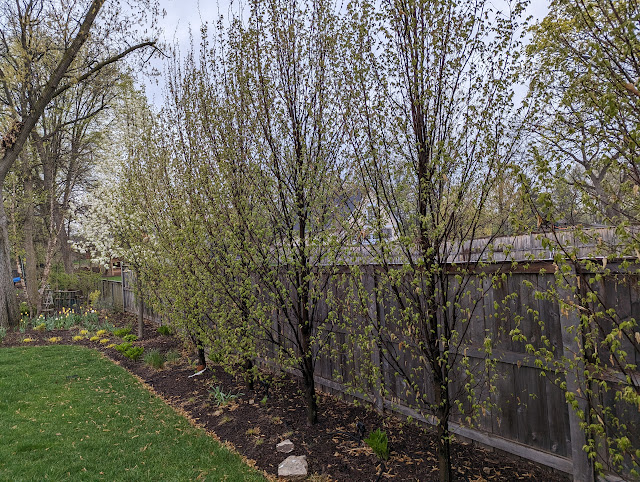
Our hedge of Frans Fontaine Columnar Hornbeam trees is waking up for Spring and has begun to leaf-out all over the trees. The last time that I looked at these trees was earlier this (late) Winter, when all of the trees were still clinging to some of their previous-season's leaves (something called foliar marcescence). The screening that comes from planting these Frans Fontaine Hornbeams along the property line is starting to come into focus this growing season as the small leaves are opening from their buds. Below, is a photo showing the current (mid/late April) state in our yard in Northern Illinois (Zone 5b). And, here below, is a look at the leaf from the Frans Fontaine European Hornbeam (Fastigata). They are curled and ribbed with a hob-like flower/fruit on the trees It won't be long until they fill-in for the year - check this post to see what these trees look like mid-Summer (July 2022) where they're screening our neighbor's yard. These trees ...


Comments
Post a Comment
Be nice to each other here.