The day finally arrived. A day that I have not been looking forward to in the life of our property. That day is the day that our large, mature Norway Maple tree that was located just outside of our front porch came down. This tree was a lovely tree. Lived a good life. We moved the location of our house foundation specifically so we could try to keep this tree. But, it still needed to come down.
It wasn't as if we didn't try to save this tree. In fact, we surely didn't want to remove it. But, it seemed liked it was necessary as the limbs kept falling and I began to become worried that it would fall on my house. Or, my neighbor's house.
Over the years, we've worked this tree. Gave it a growth regulator in September 2022. And provided a deep-feeding of this tree the past three seasons. But, that wasn't enough. The tree was in decline. The bark was falling off. The crotches were rotting out. One guy even told me that he thought it was struck by lightening. After living a great life in this spot - providing shade and cover, reducing our utility bills and making our new house feel like it could have been here years ago - it was time to celebrate the life of the Norway Maple.
Here's (below) how the tree looked on the day that the team arrived to remove it. The canopy was thin, it had plenty of bare limbs, and the bark was falling in big sheets down the trunk. But, it was *still* a nice tree.
The mid-day shade this tree provided was dappled on our driveway:
The team from the removal company started by climbing the tree, roping off limbs and using a high-point to lower the sections down to the ground. They started with the canopy and removed all the limbs. See below for a look at the guy with the chainsaw about 2/3rds of the way up the tree:
They made quick work and took down the tree limb-by-limb. See below for how they rigged up the sections and used the tree itself to lower the limbs down safely. They were total pros.
Once all the limbs were removed, they started to work on the trunk. Here (below) is a look at how they pulled down the trunk - and used sections of the tree already on the ground as a way to absorb the blow:
All was remaining was the stump. See below for the bare spot in our bed this removal left:
I asked the guys if they knew how old the tree was - as the rings were hard to interpret/read. They said they thought it was a 70-year-old tree. I didn't want the wood to go to waste. One thing I know - after buying firewood over the years - is that nobody sells Norway Maple as firewood. That means...(I think) that this tree was destined to end up as mulch. I didn't want that. So, I had the guys cut the rounds down to 16" or so and we hauled them all the way back to the rear of our property. Here, below, is one of the rounds:
I quickly built a new storage rack using the cinderblock and 2x4 system that you see online. It was easy to put together and worked well. Here, below, you can see some of the wood on the new rack:
And there were some BIG rounds that we couldn't get up there on the rack, so I left those on the ground. I'm thinking...this will sort-of FORCE me to start to split these this Winter, so they don't rot-out. See below for part of the pile of rounds:
This isn't what I wanted with this tree, but the removal certainly opens up some new opportunities with a newly created, large bed that I can plant next year. That is...once I get the stump ground out.
That's a look *up* from the ground through a young, skinny tree limb as well as a larger, more mature (and confirmed) Black Walnut tree. The leaves, from a distance look similar. Back last year, I mentioned that I wanted to try to identify if a couple of young trees were worth keeping or if I should remove them. And, knowing that I wanted to hold myself accountable, I included it as #15 on my to-do list for the yard this year . After poking around on the web in various places , I think I've settled on this clear cut detail that I found on r/WhatIsThisPlant on Reddit : Walnut tree leaves have no notches. Tree of Heaven (an invasive tree), do. From u/blacksheep998 : Ailanthus has a small notch at the base of it's leaflets. Black walnut leaflets, while slightly toothed, lacked that distinctive nub. So, that's first thing to check: Does the little tree leaves have those 'thumbs' or notches? *Looks closer*... Sure, enough....
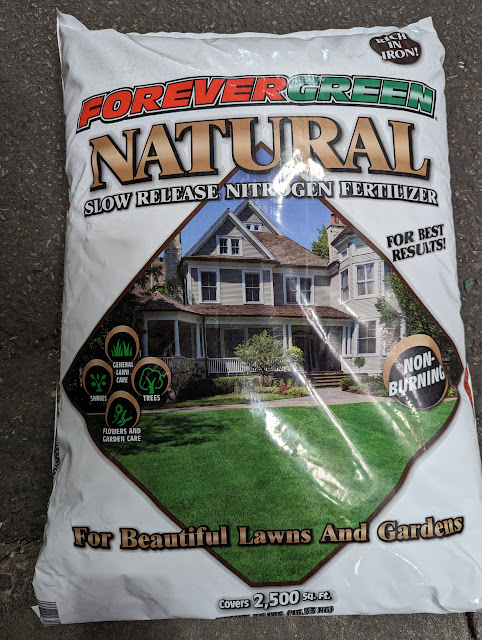
We were at the Menards in Bolingbrook and wandered out to where they keep the bags of lawn fertilizer. I was hoping to pick up a few bags of fertilizer and pre-emergent that I could put down late this Winter/early this Spring. As I've talked about over the years, I've evolved in my approach to feeding our lawn. When I started....I was all synthetic. I used the four-step program - all synthetics and some with weed/feed combined. Then...my eyes were opened (thanks to YouTube) on organics. Specifically Milorganite. I started to use biosolids. And, I stopped early Spring feedings. And, did a late season (Thanksgiving) feeding. And 'spoon fed' during the warm months and all of those things that people talk about online. Starting last year, I've kind of swung back on the synthetic --> organic spectrum. But, only half-way. I'll post about what I'm doing with the first application in another post....
September is a good time to divide some perennials in our growing zone - 5b - due to the cooler temperatures, the little bit of rain we get and the warm soil temperatures. I have a few plants in our garden that were planted in 2017 that haven't been divided to date - so that's five growing seasons without dividing. And, when it comes to some ornamental grasses, it seems that they do BEST when you divide them every three or four years. My Fall dividing plan starts with these Karl Foerster grasses that were planted next to our driveway and our front way. I just posted a photo of these grasses last week showing the trio of them being full and wide . That's about their total, mature size. Coupled with the fact that I noticed some 'center rot' this Spring , I knew it was time to dig these out and divide. I started with the grass closest to our garage - you can see it on the right in the photo below: I dug it up and divided it into quarter...



Comments
Post a Comment
Be nice to each other here.